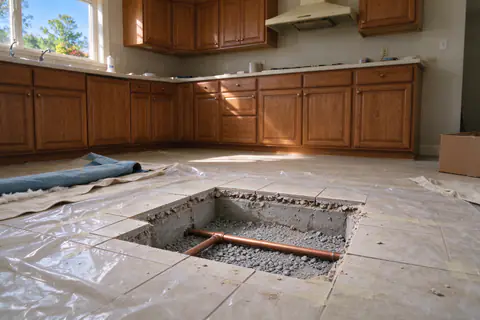
A leak under a concrete floor rarely announces itself. Here are the signs that point to one, the ordinary things that cause the same signs, and the simple test that tells you whether water is leaving the house at all.
Last Updated:
Short answerCommon signs of a slab leak are a warm spot on the floor, the sound of running water with every fixture off, a water meter that keeps moving, a jump in the water bill, damp flooring or a musty smell, and a water heater that runs more than usual. No single sign proves one; testing confirms it.
The signs of a slab leak are easy to miss because the pipe is under concrete. The water goes into the soil beneath the house, and what reaches you is indirect: a warm patch of floor, a sound, a meter that won’t stop, a bill that jumps. Level Repiping Charlotte arranges slab leak repair and reroutes across Charlotte and the surrounding counties through licensed and insured contractors, starting with tests that confirm a leak before any floor is opened. This guide lists the signs, the other things that cause each one, and how to check whether water is leaving the house at all.
Who has plumbing under a slab
Slab houses are common across Mecklenburg County, especially newer ones. County assessor records show 46.8% of single-family homes on slabs overall, rising to 71% of those built in the 2000s and 82% of those built since 2020. Pineville has the highest slab share of the county’s towns, at about 69%. Older Charlotte houses mostly sit on crawl spaces, where a leak drips onto the ground in plain view.
In a slab house the supply lines usually run under or through the concrete to each fixture group. They can be copper, and in some newer houses PEX. A leak can come from a pinhole in the pipe wall, a joint, or a spot where the pipe rubs against concrete or gravel as it expands and contracts.
The signs, and what else causes them
Every sign below can come from a slab leak. Every one also has ordinary explanations, which is why no single sign proves anything.
Sign
Why a slab leak can cause it
Other things that cause it
A warm spot on the floor
Hot water leaking beneath the slab warms the concrete above it
Sunlight, a heating duct below the floor, a hot water line that is simply close to the surface
Sound of running water with everything off
Water escaping under pressure makes a hiss or rush
A running toilet, a refrigerator ice maker, irrigation, a water softener cycle
Water meter moving with everything off
Water is leaving the system somewhere
A running toilet, a dripping faucet, an irrigation leak, a service line leak in the yard
A sudden jump in the water bill
Water is escaping all day
Running toilets, irrigation, a leak on the service line, seasonal watering
Damp carpet, cupped wood or loose tile away from walls
Water wicks up through the slab
A wall leak, a dishwasher or refrigerator leak, high humidity, a roof leak
Musty smell or mildew near the floor
Constant moisture under flooring
Humidity, a drain leak, a past flood
Water heater running more than usual
It keeps reheating water that is leaking away
A failing heating element, a thermostat setting, more people in the house
Lower pressure or flow
Water is diverted before it reaches fixtures
Street pressure, a failing pressure valve, old pipe, clogged aerators (low water pressure)
New cracks in flooring or walls
Water washes out soil beneath the slab
Ordinary settling, shrinkage, seasonal soil movement
Charlotte Water says the leading cause of a high water bill is a private plumbing leak, and its list starts with running toilets and faucets. A toilet that runs silently can waste more water than a small slab leak, so rule it out first.
The meter test
The meter test answers the first question: is water leaving the house when nothing is running?
Turn off every faucet, the ice maker, the washing machine and irrigation. Make sure no toilet is filling.
Find the water meter, usually in a box near the street, and lift the lid.
Watch the dial or the small leak indicator for several minutes. Note the reading.
If it moves, close the main shutoff at the house and check again.
If the meter stops when the house shutoff is closed, the leak is inside the house, and a slab leak is one possibility. If it keeps moving, the leak is likely on the service line between the meter and the house. The water line ownership guide explains why that part is the owner’s.
Toilet dye tablets or a few drops of food coloring in each toilet tank rule out the most common silent leak: if color appears in the bowl without flushing, the flapper is leaking.
Hot side or cold side
A warm spot on the floor is strong evidence that the leak is on a hot water line, and so is a water heater that runs when no one is using hot water. A cold line leak gives no warmth. It shows up through the meter, the bill or damp flooring. Telling which side is leaking matters because it narrows where the leak is and shapes the repair.
What confirms a slab leak
Signs suggest; tests confirm. Leak detection for a slab usually combines several methods: isolating the hot and cold systems and pressure testing each one, listening for the leak with acoustic equipment, and sometimes thermal imaging to follow a warm line under the floor. The aim is to confirm that a leak is under the slab, which line it is on and roughly where, before any concrete is cut. The water leak detection page covers how that testing runs.
What happens after a slab leak is found
There are two broad paths. A spot repair opens the floor at the leak, fixes that section and closes the floor again. It is the smaller job, and it leaves the rest of the under-slab pipe in service. A reroute abandons the under-slab lines and runs new pipe through the attic and down interior walls to each fixture, so nothing is left under the concrete to leak. Mecklenburg permit records include a slab house rerouted to move all waterlines into the attic to eliminate the lines under the slab.
Which path fits depends on the age and material of the pipe, whether this is the first leak or one of several, and what the flooring is. A first leak in otherwise sound pipe often points to a repair. Repeat leaks in old copper point toward a reroute or a whole house repipe. The repipe or repair guide and the copper pinhole leaks guide go further.
What to do now
Shut off the main and call a plumber right away if water is surfacing through the floor, flooring is soaked, or the leak is near electrical outlets or appliances. If the only sign is a meter that creeps, there is time to rule out toilets and irrigation first and then arrange testing. Either way, write down when you noticed each sign and save recent water bills, because both help the person testing. The repipe cost guide covers how slab houses affect the price of a reroute or repipe. To talk through what you’re seeing, call (704) 452-4386.
Questions
More questions on this
Can a slab leak be on the hot water line only?
Yes, and it is the easiest kind to notice, because hot water leaking under the floor warms the slab above it and keeps the water heater running. A cold line leak gives no warmth, so it usually shows up through the meter, the water bill or damp flooring instead. Testing the hot and cold sides separately tells which one is leaking.
Why do slab leaks repeat in the same house?
Because the conditions that caused the first one are still there. The rest of the pipe under the slab is the same age and material, and it sits in the same soil and against the same concrete. A spot repair fixes one point, which is why some owners choose a reroute that moves all the lines out of the slab.
How do I tell a slab leak from a leak inside a wall?
A wall leak tends to show at the wall: a stain, bubbling paint, or damp baseboard on one side. A slab leak shows in the floor: warmth, damp carpet or swelling flooring away from any wall, or nothing visible at all with the meter still moving. Some leaks sit where a line rises out of the slab into a wall, so testing settles it.
Get an Estimate for slab leak repair
Tell us the age of the house, the pipe you have seen and what is going wrong. Or call.
One leak on sound pipe is a repair. A pattern of leaks, or a pipe with a known failure history, is a question about the whole system. The evidence that separates the two is usually in the house.
Charlotte Water draws a clear line at the meter. Here is what the utility owns, what the property owner owns, how to tell which side a leak is on, and when the service line is worth replacing with a repipe.
Copper fails from the inside, usually at one spot first. The cause can be the water, the speed it moves, how the pipe was installed or the tube itself, and often more than one of those at once.
The typical Charlotte range for a whole house PEX repipe, why copper is quoted separately, how the Mecklenburg permit fee is set, and which parts of the job only a walk-through can price.
Charlotte freezes most winters and sees a hard freeze every few years. Here is why crawl space and attic pipes are the ones that split, what the state code requires, and what helps before and after a cold night.